
4×4 Feet of Happiness on the Slopes of Pilis
Many horse and dog owners dream of one day being able to keep all their animals at home, but few know how—or dare—to take the plunge. Eszter Kövesi’s life is intertwined with her four-legged friends in many ways, and she recently managed to weave those threads together. She told us about her life with horses and dogs in the Pilis Mountains.
Let’s start at the beginning—how did the horses and dogs come into your life?
For as long as I can remember, I’ve been a huge animal lover; as a child, instead of posters of pop stars, I mostly decorated my bedroom walls with pictures of horses and dogs. We lived in a prefab apartment building until I was a teenager, so I didn’t get my own pet until relatively late, and my parents couldn’t afford to let me take riding lessons back then, so I made do with standing by the pastures and daydreaming. When we moved into a house with a yard, I got my first dog and cat, and I didn’t start riding until college, as part of my physical education class. Later, as a photographer, I loved taking pictures of horses; for years, I also took photos for Lovas Nemzet, and as a psychologist, equine therapy became one of my areas of specialization. We bought my first horse, Liza, in my late twenties, and my second horse, Kalóz, went on to become a therapy horse with me. My dogs have also always come in pairs over the years; they’ve all lived to a ripe old age, and currently Folti and Panni make up the pack here at home.
It was also a childhood dream of yours to one day live together with all your animals—how did that come true?
For nearly fourteen years now, I’ve kept horses at various stables, and with a few exceptions, I’ve been in a constant state of worry—wondering how they were doing, whether they’d been let out into the paddock that day, what kind of feed they’d been given, or fretting over how many days it had been since I’d been out to see them and that they really needed to be exercised— It was a constant race against time and distance. On top of all that, I had to decide whether to spend the day with the dogs or the horses, since most riding stables didn’t allow dogs inside. Two years ago, a miracle happened: I managed to move to a small village in the Pilis Mountains, where I could finally gather all my animals in one place. I had a two-stall barn built at the far end of the property attached to the house, and I turned the empty lots next to mine into pastures for them.
Did living together live up to your expectations?
Not only did it come true, but it was multiplied many times over! I’ll never forget that first morning when everything was finally ready and I could bring them home. From my living room window, I caught my first glimpse of my two beautiful horses, who were peacefully basking in the light of the rising sun. I had a feeling of déjà vu in that moment—even though it had never actually happened to me before, I’d dreamed about it so many times. Finally home, finally together. Every morning since then, as I watch them from the patio (or from the living room in winter), I sip my morning coffee in the company of my dogs and give thanks for being able to live this way. Of course, I’ve experienced both the highs and lows of keeping horses here—from the moment I step out of the garage with the saddle in my hand and, a few minutes later, find myself on horseback in the woods, to the point where, on winter mornings, I use a hair dryer to thaw the frozen water spigot or push a manure wheelbarrow through knee-deep mud in rubber boots. But the feeling that I know they’re safe, and that I can sit down next to them in the pasture at any time and watch them graze peacefully, makes every hardship worthwhile. I don’t know if it’s the quiet peace of the Pilis Mountains, the care that comes with keeping them here, or my own sense of calm, but it has brought the horses a peace I’ve never experienced before. My mare—a high-blooded, more nervous type who struggled with weight issues—has been consistently calm ever since; she’s gained about 100 kilograms, and at twenty years old, she’s more beautiful than ever.
How did your dogs react when the new residents moved in?
My two dogs at the time already knew them well from the previous riding school, so they greeted each other like old friends. Since then, my old dog has passed away, and his successor—at three months old—was quite distressed when he first saw them. I remember that all my dogs reacted similarly during their first encounter: a mix of incredible excitement, fear, and curiosity. They tried to get close, bark angrily, and intimidate them, but then they realized the horses were more afraid and ran away—only to be drawn back by their curiosity. When my dog Folti first saw me on horseback, he started barking and nudging the horse’s shoulder with his front paws; he didn’t understand what I was doing up there, and I thought he was trying to protect or save me. Then, when we set out together into the countryside, he realized we were a pack—in fact, he often herded us from behind in a U-shape. By now, the four animals have become a complete team; they know and love each other. Pannika’s first task in the morning is to go down to the horses, and she usually brings a stuffed toy, which she gently places next to Kali. Kali, of course, doesn’t play with it, but she sniffs it, and then the two of them sit there, gazing into the distance. They also love playtime, when they can play and roll around in the clean straw, and their absolute favorite is hoof-grooming, when they can sneak a bite of the trimmed hooves.
You mentioned going off-road together—what has been your experience with that?
This was also one of my greatest desires, which, fortunately, came true even before I moved back home. In fact, at one point I was taking two horses and two dogs out for walks. I often take the horses out together—I ride one while the other is led on a lead rope—and the dogs join them. This might seem complicated, but I’ve noticed that when they sense that the five of us are a herd or a pack, they function as one; everyone pays attention to everyone else, and everyone senses and feels the others. We’re almost on the same wavelength; there’s no need to specifically direct anyone—the harmony works organically. Even though they aren’t of the same species, this is an amazing example of synchrony among animals. The way I gave a slight nudge to the gallop, and the horse beneath me, the horse next to it, and the two dogs all ran in unison, as one, across the endless fields. Of course, there were times when my puppy at the time came home in the saddle because his tiny legs couldn’t keep up with the bigger ones. Now that I live in the Pilis Mountains, I feel it’s safer not to take them out together—there’s a lot of wildlife here, and of course, on weekends there are tourists too, all of whom could scare or distract the animals, and I can’t responsibly look after all four of them.
Have you noticed any changes in yourself since you’ve been living this way?
Absolutely! Just like a horse grazing peacefully, I’ve slowed down—not only my pace of life, but even my speech and movements have become slower and calmer. Being close to nature fills me with a sense of peace that I think is incomparable to anything else, and having my animals here in this environment has truly given me a sense of oneness—the feeling that I’m part of a larger whole, that together we are one.
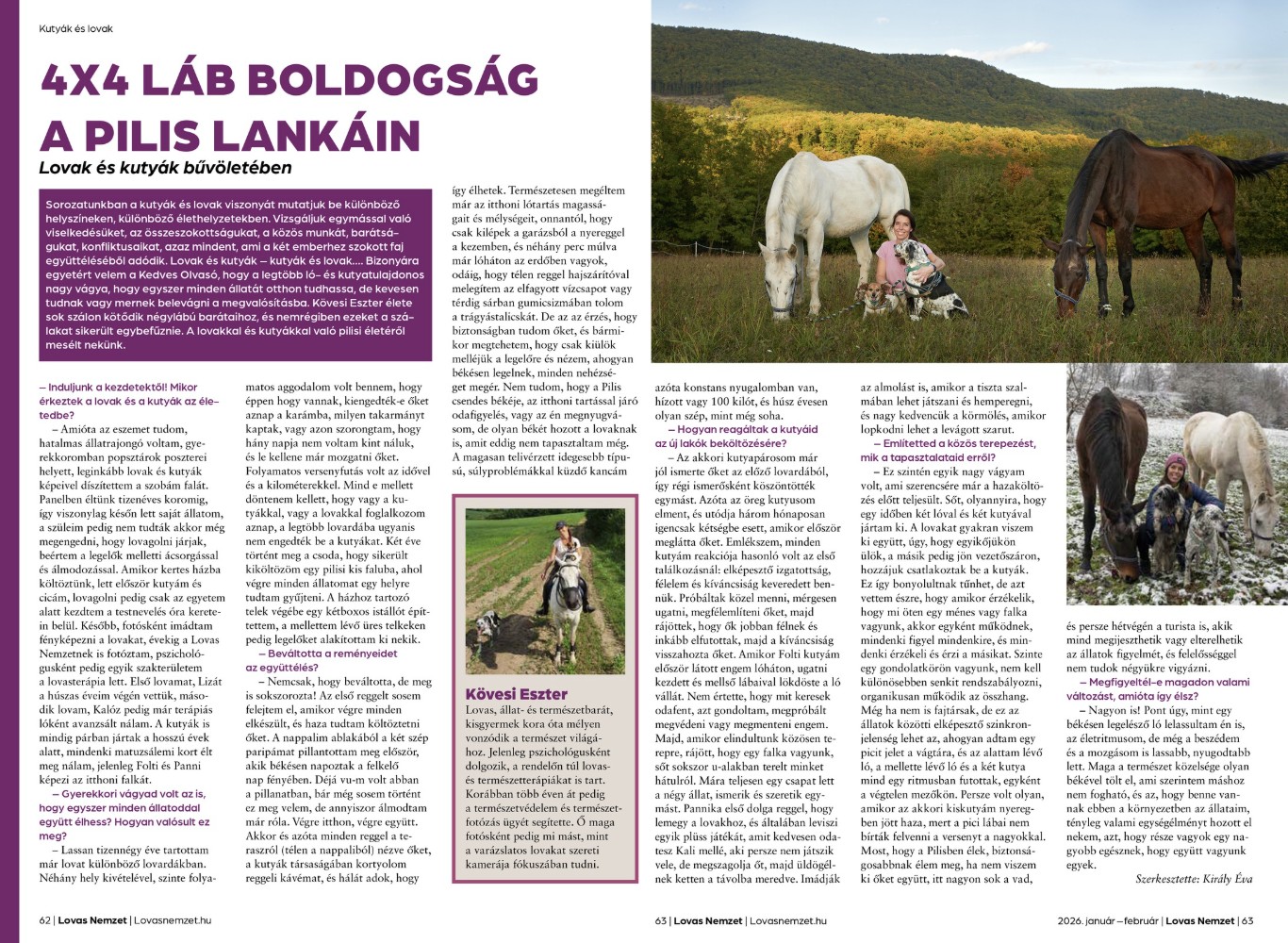
Eszter Kövesi
A lover of horses, animals, and nature, she has been deeply drawn to the natural world since she was a small child. She currently works as a psychologist, offering equine and nature therapy sessions in addition to her clinical practice, and has spent years advocating for nature conservation and nature photography. As a photographer herself, what else could she love more than having those magical horses in the focus of her camera?